Divine Mercy Sunday holds a special place in my heart as it is the day my husband came into full communion with the Catholic Church. He was baptized and raised in a Christian home and the grace of his baptism was evident. He was a well catechized Christian. He knew the depths of God’s love and he knew that God had a precise call on his life. We had dated for less than a year but we knew quickly that we were being called to the vocation of marriage, a path in which we needed to be equally yoked in faith. Of course, we didn’t know what curve balls this vocation would throw us – we still don’t – but the reality that we needed to walk it together, was clear.
If you know my husband, you know he’s an inquisitive man. He is not going to accept something because you tell him it’s true. He will do his own research, he will ask the hard questions, and he will play devil’s advocate to get you all riled up even if he’s reached the conclusion you had hoped for. The year of his formation was a formation for me as well. So many of the things I had accepted as a Cradle Catholic I was now called to defend. I had to dive in, I had to understand to explain, and I needed grace to do that.
We were in college and therefore away for the Easter Vigil, so he came into the church the following Sunday, April 19, 2009. I always joke that he cheated in avoiding the 3-hour Easter Vigil, but I can’t help but wonder if there was a special kind of grace granted for him to be received into the church on this non-conventional day.
As we’ve journeyed through life these last 15 years, we’ve learned a thing or two about mercy. We’ve learned about Jesus’ mercy as well as our own call to mercy, to each other and to this family we’ve been entrusted with. We’ve begun to learn what it means to love well and be loved and to do it by showing mercy and asking for mercy.
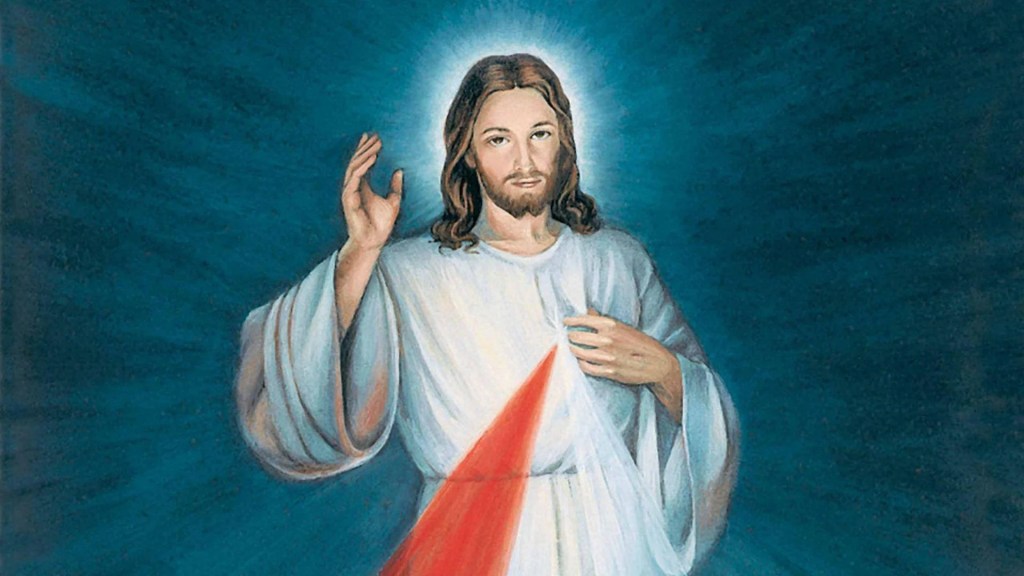
The Feast of the Divine Mercy was officially designated as the Second Sunday of Easter in 2000 with the canonization of St. Faustina. St. Faustina Kowalska was a Polish nun of the Congregation of Sisters of Our Lady of Mercy in the 1930s. She came from humble means and had only limited education, but the Lord used Sister Faustina in a profound way. On February 22, 1931, Faustina was visited by Jesus. She writes,
“In the evening, when I was in my cell, I became aware of the Lord Jesus clothed in a white garment. One hand was raised in blessing the other was touching the garment at the breast. From the opening of the garment at the breast there came forth two large rays, one red and the other pale. In silence I gazed intently at the Lord; my soul overwhelmed with fear, but also with great joy. After a while Jesus said to me, ‘paint an image according to the pattern you see, with the inscription: Jesus, I trust in You.’” (Diary No. 47)
Over the next seven years until Faustina’s death, she would record her visits with the Lord in notebooks which are now compiled into “The Diary of St. Faustina.” The words Jesus shared give us a glimpse into the profound depths of His mercy and offered instruction for our devotion to this feast.
The message of The Divine Mercy can be summarized into three distinct aspects for our prayer.
Ask for Mercy
Jesus does not withhold His mercy but we need to ask. We must seek Him in prayer, repent our sins and ask him to pour His mercy on us.
Be Merciful
In receiving Jesus’ mercy, we must also be merciful to others, extending love and forgiveness to all those we encounter
Completely Trust in Jesus
The inscription Jesus requested on the image of the Divine Mercy is “Jesus, I trust in You.” We must believe fully in the power of Jesus’ Divine Mercy in our lives so we can receive it.
Jesus gave us many ways by which to venerate and pray for His mercy.
Feast
“I want the image solemnly blessed on the first Sunday after Easter, and I want it to be venerated publicly so that every soul may know about it. (Diary No. 341)
Image
“I demand the worship of My mercy through the solemn celebration of the Feast and through the veneration of the image which is painted. By means of this image, I shall grant many graces to souls. It is to be a reminder of the demands of My mercy, because even the strongest faith is of no avail without works.” (Diary No. 742)
Novena
“By this novena, I will grant every possible grace to souls.” (Diary No. 796)
Chaplet
“Say unceasingly the chaplet that I have taught you. Whoever will recite it will receive great mercy at the hour of death. Priests will recommend it to sinners as their last hope of salvation. Even if there were a sinner most hardened, if he were to recite this chaplet only once, he would receive grace from my infinite mercy. I desire to grant unimaginable graces to those souls who trust in My mercy.” (Diary No. 687)
Hour
“At three o clock, implore My mercy, especially for poor sinners; and, if only for a brief moment, immerse yourself in My Passion, particularly in My abandonment at the moment of agony. This is the hour of great mercy for the whole world. I will allow you to enter into My mortal sorrow. In this hour, I will refuse nothing to the soul that makes a request of Me in virtue of my passion.” (Diary No. 1320)
And so, on this Feast of Divine Mercy, may we venerate and pray as Jesus himself asked.
May we know the flood of mercy that washes us clean, so that we may live forever with Him.
The above recording was done in 2020 by my husband and I, at the height the Covid Lockdown.
Vocal: Liesl Schiavone Piano: Matt Schiavone
Copyright 2002 Marian Fathers of the Immaculate Conception of the B.V.M. Composed/Arranged by Trish Short



 SacraMom.com
Leave a comment